Recursos generales
Siempre deben consultar los marcadores textuales mientras escriben sus ensayos o entradas en la bitácora.
Diccionarios RAE y Panhispánico de dudas
Creative Commons for public domain images that aren’t bound by copyright.
MLA Style Synopsis: This handout both describes and models MLA Style for print media. You may need to adapt MLA Style to digital environments. The important thing, whether working in print or digital form, is to identify all sources quoted, paraphrased, or consulted, and provide a link or citation that will guide your reader to the original source.
Provide a source for anything you cite; this can be done via linking. If it’s a PDF for class, just give author, title, and page number (of the original, not the PDF file). Spring 2021: You do not need to bother with MLA style citations.
The Purdue OWL “MLA Formatting and Style Guide“ is a great, searchable resource for figuring how to cited different types of print and digital texts, including films, paintings, videos, lectures, conversations, etc.
Instrucciones para los comentarios de texto
“Close reading” (“comentario de texto”) is a technique of textual analysis that involves the careful, sustained interpretation of a brief passage of text. It consists of observation, analysis, and synthesis into a broader argument. Such a reading places emphasis on the particular over the general, paying attention to individual words, syntax, genre conventions, and the order in which sentences and ideas unfold as they are read. Attention to these details often supports arguments about a text overall.
Technical
Steps
1. Observation:
Pick a passage that seems particularly rich, dense, or complicated. Read slowly and carefully. Circle or underline anything that stands out: repeated words or phrases; odd or particularly pleasing language patterns; shifts in tense or voice; moments that seem to articulate significant ideas; analogies; allusions to other texts; and images or figures of speech that help or hinder your understanding. Make notes in the margins. Don’t just look up words you don’t know; look up almost all the words so that you can better identify words that the author uses in an interesting way.
When turning to your writing, pose your observations clearly to the reader. Consider choices the author has made in selecting particular words, phrases, sentences, and punctuation to express herself. Address how your passage treats at least 3 of the stylistic conventions below for a weekly post and at least 6 for the paper:
- Diction: What is the source of the language, i.e., out of what kind of discourse does the language seem to come? Did the author coin any words? Are there any slang words, innuendoes, puns, or terms with ambiguous or double meanings? Do the words have interesting etymologies?
- Structure: Examine the structure of the passage. How is the passage organized? Are there climaxes and turning points? Is it suspenseful?
- Sound and Rhythm: Acquire a feel for the sound, meter, and rhythm (but always note if it’s produced in translation). Be alert to devices such as alliteration, assonance, rhyme, consonance, euphony, cacophony, onomatopoeia. Examine the meter of the passage in the same way. Is it regular or not? Determine whether the line breaks compliment or complicate the meanings of the sentences.
- Syntax: Examine the syntax and the arrangement of words in the sentences. What is the rhythm of the sentences? How does the word order influence meaning? Does the syntax allow for ambiguity or double meanings? How is the author using repetition, incantation, and/or listing/enumeration?
- Textual Context: What role does the passage play in the text overall?
- Irony: How does dramatic or situational irony operate in the passage, if at all?
- Tone and Narrative Voice: What is the speaker’s (as distinct from the narrator’s and author’s) attitude towards his or her subject and hearers? What does the passage reveal about the speaker? Who is the narrator? What is the relationship between the narrator and the speaker? Is there more than one speaker?
- Imagery: What sort of imagery appears in the passage? What do the images connote? Does the passage noticeably lack imagery? If so, why?
- Rhetorical and Literary Devices: Note metaphors, similes, images, or symbols especially ones that recur in the passage or that were important for the entire text. How do they work with respect to the themes of the passage and the text as a whole? Are there any other notable rhetorical devices? Are there any classical, biblical or historical allusions? How do they work?
2. Introduction and development of the close reading
Now you are ready to start drafting!
You should begin the close reading itself with a brief introduction that situates the passage(s) you will focus on, without too much plot summary or unnecessary contextual information. Name the author, the title, the genre, the time period, and tell your readers where the passage occurs (e.g. at the conclusion of X plot point, at the opening of the story within the story, the closing couplet of a sonnet).
You will then present the most relevant parts of your observation in your draft. Never afraid to be too obvious in your description of what’s happening in the passage you are analyzing. Do not just say, for example, that irony is operating here; demonstrate exactly where and how it is operating. After you’ve presented the longer quote in full, re-cite it; that is, use specific words and phrases from the longer quote again and again when you write your observation and analysis of them. Citing specific words and phrases again, and putting them in between quotation marks, will help your reader focus on the parts of the quote you think are important, guiding them toward a better understanding of the contours of the argument you are making. See how this works with “geografía” and “finisecular” in the example below.
3. Analysis:
Now take a step back from your writing. Look at the moments you’ve noted in the text and determine their relationship to each other. Are there formal patterns? Do individual details in the passage come together to make or support an argument? How does this passage compare to other descriptions or scenes within the novel/broader work as a whole? Do the details you’ve noticed point to a subtext below the surface content of the text? What events, texts and/or social, economic, and political circumstances might this passage respond to? In your analytical section of the essay, demonstrate to your reader how your analysis of the context and formal patterns helps illuminate the meaning of the passage as a whole. This will serve as evidence for your final step (not required for blog posts, but required for the longer paper) that synthesizes your observations and analysis into an interpretation of the passage.
4. Synthesis (this step is usually more appropriate for longer papers and is not required for the blog posts):
Based on your observations and analysis, construct one or a series of related interpretative claims that are based in evidence from your chosen passage. In concluding your essay, show how your reading of this passage illuminates the concerns, themes, and issues of the text as a whole. This may not be realistic for a 300-word blog post, and it is not required in the blog posts, but it is required in the longer paper.
Other Compatible Descriptions of Close Reading Techniques You May Consult:
http://www.fas.harvard.edu/~wricntr/documents/CloseReading.html
http://www.personal.psu.edu/users/s/a/sam50/closeread.htm
http://theliterarylink.com/closereading.html
http://www.brocku.ca/english/jlye/criticalreading.html
Ejemplo de un comentario de texto
Comentario de “Lección de geografia finisecular” de Guillermo Gómez Peña
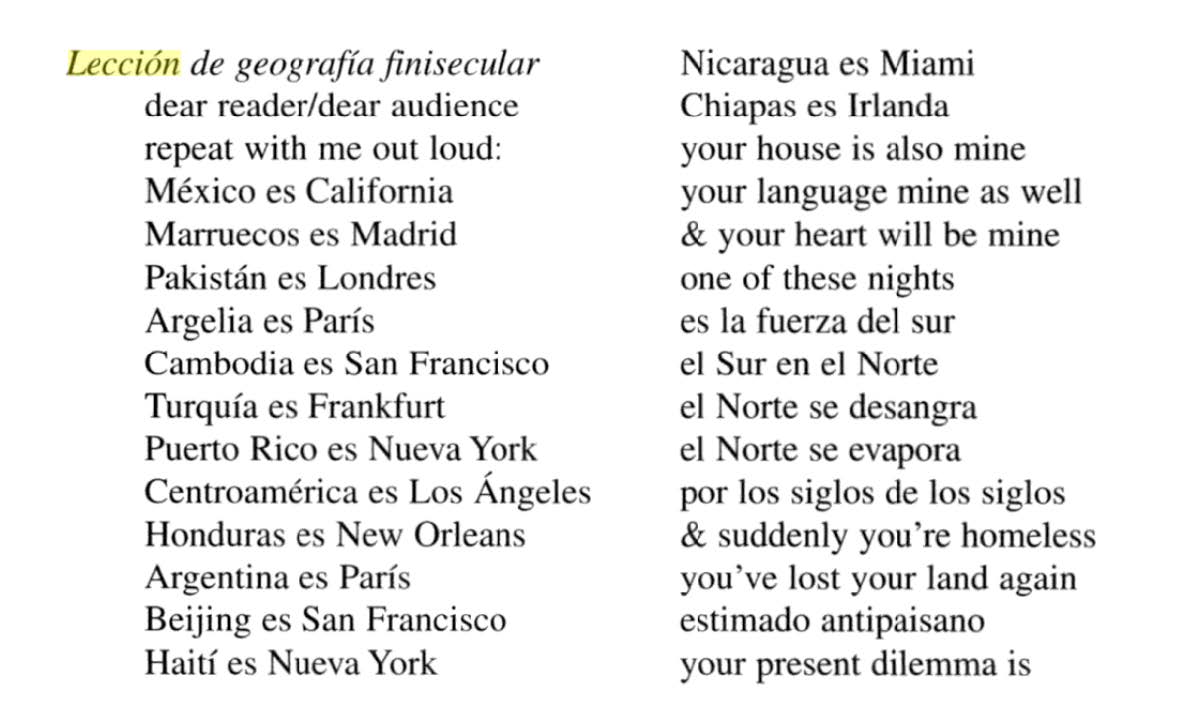 La primera palabra del título del poema, “Lección de geografía finisecular,” evoca las lecciones de la escuela y el ámbito institucional de la escuela, pero las siguientes palabras complican bastante esta asociación con lo normativo. La yuxtaposición inesperada de “geografía” y “finisecular” sugiere que la geografía es algo que puede cambiar, ya que se cualifica la “geografía” como perteneciente al fin de siglo. Por una parte, esta yuxtaposición sugiere la cartografía antigua y los mapas que ya no usamos, pero, por otra parte, la palabra “finisecular” sin contexto específico excepto el libro de 1996 en que se publicó el poema, sugiere el fin del siglo 20. Entonces, se trata de la geografía contemporánea, a finales del siglo 20, y se sugiere que nuestra geografía está históricamente condicionada y que las fronteras aún pueden cambiar. Es imposible no asociar a Gómez Peña con la(s) frontera(s), ya qua la mayoría de su producción cultural intenta conceptualizar y problematizar la frontera.
El poema empieza apelando al lector con “dear reader/dear audience.” Hay un cambio de códigos ya que el título está en castellano y la primera línea en inglés, algo que nos advierte que el poema va a seguir cambiando de códigos. Además, las minúsculas ponen énfasis en el hecho de que este poema no va a seguir las convenciones poéticas ni respetar al lector en la manera más tradicional. La barra diagonal entre “dear reader” y “dear audience” sugiere simultáneamente una división y una comparación o unión entre la figura del lector y del público, acordándonos de la multiplicidad de géneros y medios que trabaja Gómez-Peña…


Comentarios recientes